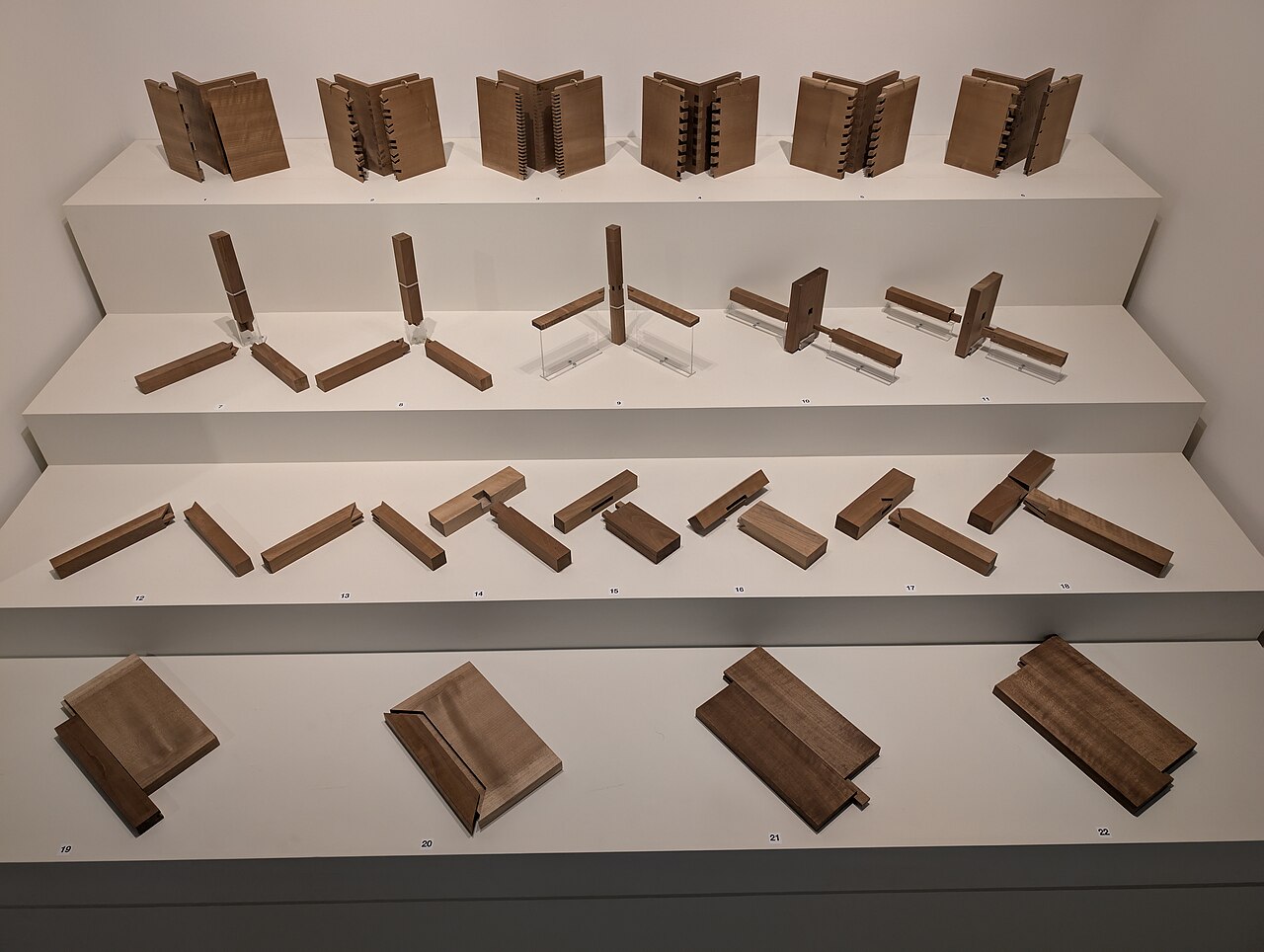
Sashimono joinery examples · The Craft of Carpentry, Japan House London, 2025. Photograph: Andy Li / CC0.
01 / THE ORIGINS OF THE STORY
Before it is a technique, it is a way of paying attention.
Saşimono — internationally known as sashimono — is a tradition of making furniture, boxes and everyday objects by joining wood with precise interlocking joints. It is not the name of a single joint. The grain, dimensions, surface and place of each part within the whole are considered together.
The connection is formed through the shape of the wood itself. The tradition is widely known for construction without metal nails, but this does not mean that every piece is entirely free of metal or glue. Adhesives, handles and hinges may be used where the piece requires them.
KYOTO · HEIAN PERIOD
From the palace to everyday life.
The Kyoto tradition is associated with the court culture of the Heian period (794–1185). During the Muromachi period (14th–16th centuries), specialist craftspeople and the development of tea culture deepened the care given to small wooden objects.
EDO · 17TH–19TH CENTURIES
The expression of the wood itself.
Edo is the historical name of present-day Tokyo. During the shogunate, craftspeople arriving in the city made objects for samurai, merchants and the kabuki world. Edo sashimono developed a distinctive emphasis on simple forms and surfaces that reveal the natural grain of wood.
A LIVING TRADITION
From master to hand, from hand to time.
Edo Sashimono was recognised as one of Japan’s national traditional crafts in 1997. Its value lies not simply in its age, but in the knowledge of measuring, cutting and joining that continues to live through the making.
02 / WHERE STRENGTH IS HIDDEN
Two pieces. Two spaces made for one another.
The geometry of a joint determines how the parts hold together. The choice of joint depends on the direction of the load, the grain of the wood and the intended use. The examples below illustrate this principle; they are not joints exclusive to Japan.
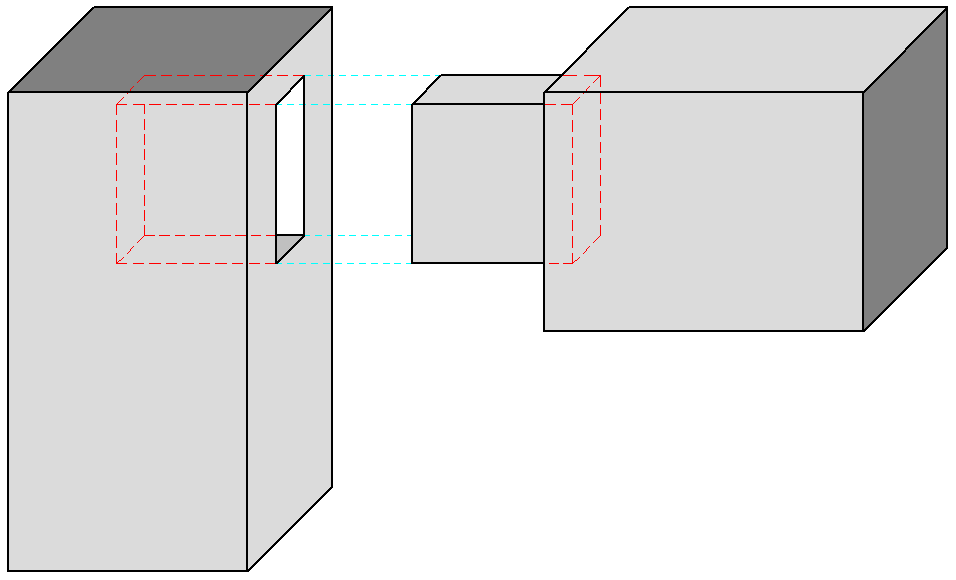
Mortise and tenon · technical diagram. Luigi Zanasi / CC BY-SA 2.5.
Hozo · Mortise and tenon
A projection at the end of one piece fits into a socket in the other. The cheeks and shoulders of the tenon determine both the fit and the transfer of load. Precise cutting allows the parts to meet without force or unnecessary gaps.
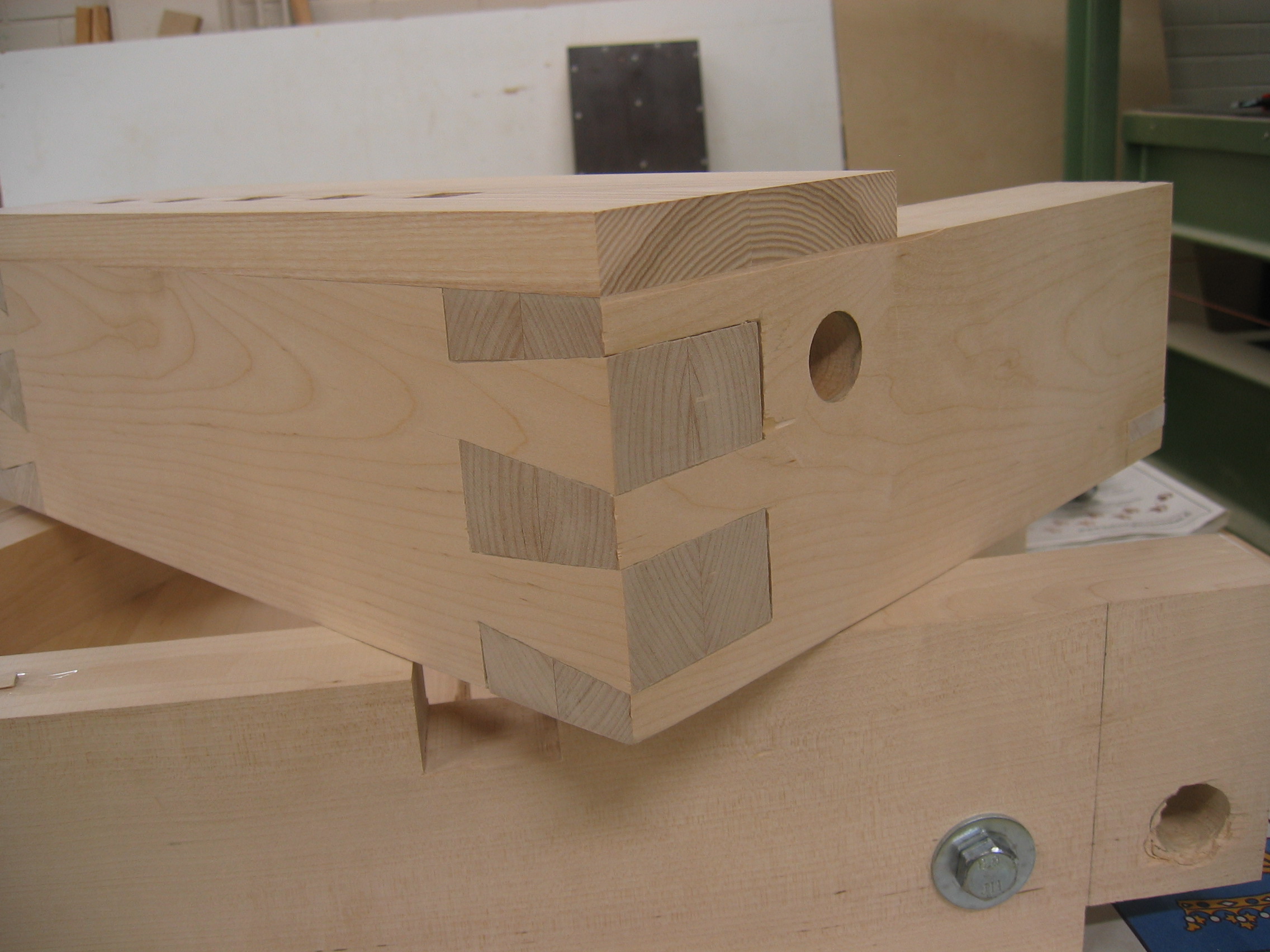
Close-up of a dovetail joint on a workbench; not an Edo piece. Emhoo~commonswiki / CC BY-SA 3.0.
Dovetail · An interlocking form
Flared tails fit into matching spaces in the adjoining piece. Their wedge-shaped profile provides a mechanical hold against the direction in which the parts would pull apart. Variations of this principle appear in corner joints for boxes and drawers.
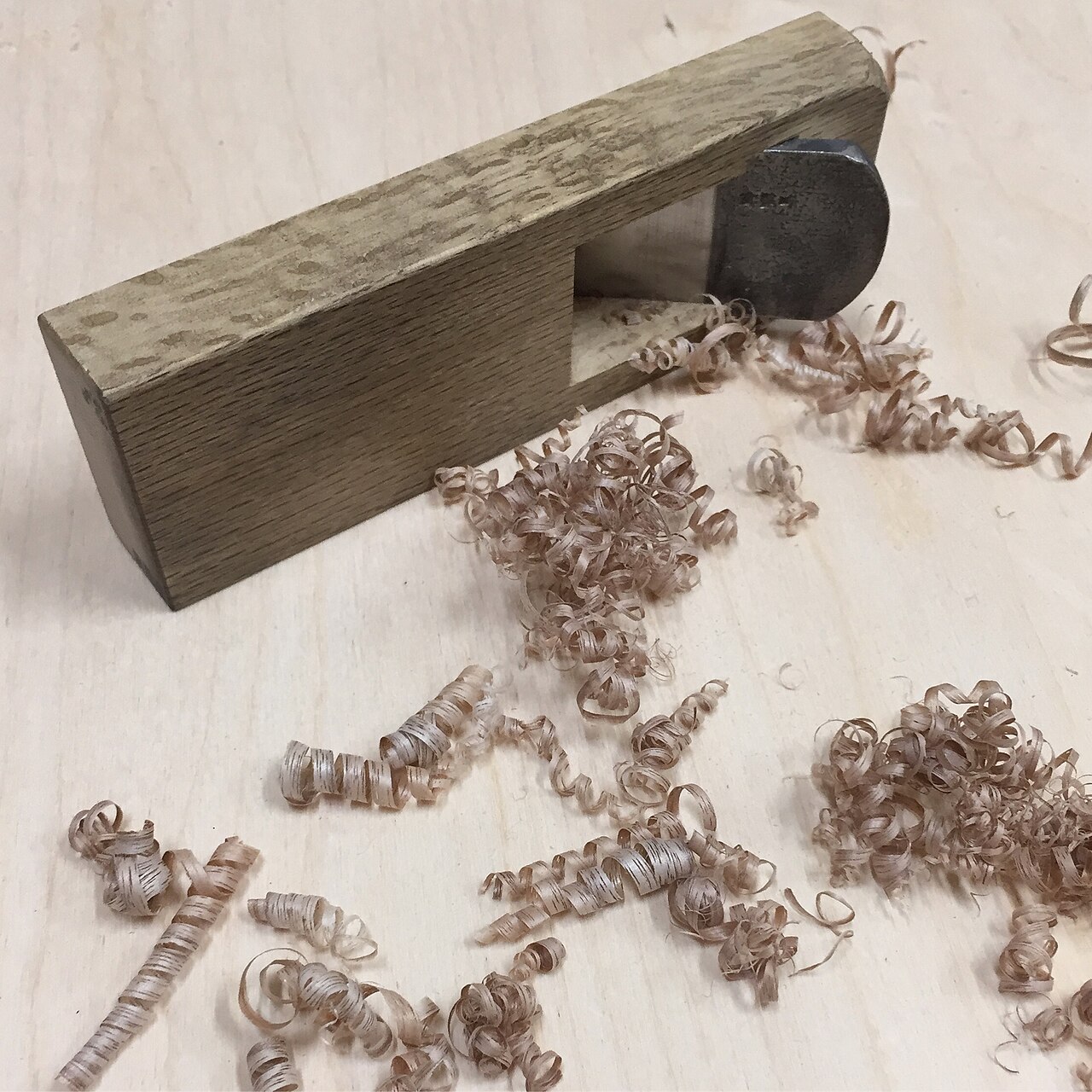
Kanna, a Japanese hand plane · Teresa Audet’s workshop. Photograph: Terasaface / CC BY-SA 4.0.
THE MEMORY OF THE HAND
Precision continues to the final touch.
The saw, the chisel and the kanna Japanese hand plane each play a different part in turning a measurement into a finished surface. The chisel shapes the socket; the plane lifts fine shavings from the surface. Reading the grain is as important as the sharpness of the tool.
A joint is often entirely hidden from the outside. Craftsmanship reveals itself as much in the details it conceals as in those it shows.
03 / FROM PART TO WHOLE
Patience is part of the making.
These are the basic stages of traditional making. Details vary with the type of piece and the craftsperson’s method.
Understand the wood
The species, grain direction and imperfections are examined. The wood is dried and prepared for its working environment. Mulberry, keyaki (Japanese zelkova), kiri (paulownia) and hinoki (Japanese cypress) are among the species used in the tradition.
Measure and mark
The parts and joints are planned. Reference lines are marked with rulers and marking tools; even the side of a line on which a cut is made affects the result.
Cut the joints
Saws and chisels shape the tenons, sockets and corner details. Material is removed a little at a time. The aim is not to make two parts the same size, but to make them fit one another.
Test and adjust
The joints are dry-fitted first. Their fit, corners and overall balance are checked. Final assembly follows any necessary adjustments.
Finish the surface
The surface is refined with a hand plane. In fuki-urushi, one traditional finish, a thin layer of urushi lacquer is applied, the excess is wiped away and the process is repeated. This finish is not used for every piece; the choice depends on its intended use.
Wood is a living material: it moves as humidity and temperature change. A well-designed joint accommodates this behaviour. Precise craftsmanship does not make wood independent of its surroundings.
04 / AT ASLAN ATELIER
Knowledge from Japan. Wood with a past.
For us, this tradition means listening to the wood as we make. Instead of new timber, we work with wood that has already been part of another life. Its grain, knots and the marks of time become part of the piece’s character.
Reclaimed wood is our own material choice, rather than a historical requirement of sashimono. We bring the tradition’s precise approach to joinery together with the memory of wood given a new life here.
These reference images illustrate the techniques; they are not photographs of Aslan Atelier production. The files are shown without alteration, scaled to fit the page.